Chronic Kidney Disease Research: Mitoquinol (MitoQ) and Vascular Function in Stage 3–4 CKD
Written by Tyla Cornish (BNatMed), Naturopath. Reviewed by Dr. Siobhan Mitchell (PhD), Neuroscience.
Cardiovascular risk in chronic kidney disease (CKD) is not fully explained by traditional risk factors. Instead, vascular endothelial dysfunction and microvascular impairment are key features of the condition and major contributors to overall disease burden. Because CKD is also associated with mitochondrial dysfunction and increased oxidative stress, this studyinvestigated whether targeting mitochondrial redox imbalance could improve vascular function in patients with moderate CKD.
Research Summary
Evidence type: Randomised, double-blind, placebo-controlled pilot trial
Claim strength: Causal (physiological endpoints), pilot-scale
Population: 18 adults with stage 3–4 non-dialysis CKD
Intervention: Oral MitoQ 20 mg/day vs placebo (4 week period)
Primary outcomes: Endothelial function (flow-mediated dilation, FMD); microvascular function; arterial haemodynamics; exercise capacity
Observed outcome: Improved endothelial function; improved or stabilised vascular haemodynamics; trend towards improved microvascular function; no change in exercise capacity
Causality: Supported for short-term physiological endpoints
Primary source: American Journal of Physiology – Renal Physiology
What you’ll learn
Whether targeting mitochondrial oxidative stress can improve vascular function in chronic kidney disease
How endothelial dysfunction contributes to cardiovascular risk in CKD
Why early-stage vascular changes may represent a key intervention window in CKD
The Role of Mitochondrial Oxidative Stress in CKD
Patients with CKD experience increased oxidative stress alongside impaired mitochondrial function, contributing to reduced nitric oxide availability, endothelial dysfunction, and microvascular impairment. These vascular changes are central to the elevated cardiovascular disease risk seen across CKD stages and may begin early in disease progression, before overt cardiovascular events occur.
How Might MitoQ Influence Vascular Function?
MitoQ is designed to accumulate within mitochondria and reduce oxidative stress at its source. By improving mitochondrial redox balance, it may enhance endothelial signalling and vascular responsiveness. This study specifically tested whether reducing mitochondrial oxidative stress could translate into measurable improvements in vascular physiology in a population where such dysfunction is both prevalent and clinically consequential.
What the Study Observed
Participants were randomly assigned to receive either MitoQ (20 mg daily) or placebo for four weeks, with vascular function, haemodynamics, and exercise capacity assessed before and after the intervention. MitoQ supplementation led to significant improvements in flow-mediated dilation, indicating enhanced endothelial function, as well as stabilisation of vascular haemodynamics — a deterioration observed in the placebo group but not in those receiving MitoQ. A trend towards improved microvascular function was also observed, though this did not reach statistical significance. Exercise capacity and cardiorespiratory fitness were unchanged over the short intervention period.
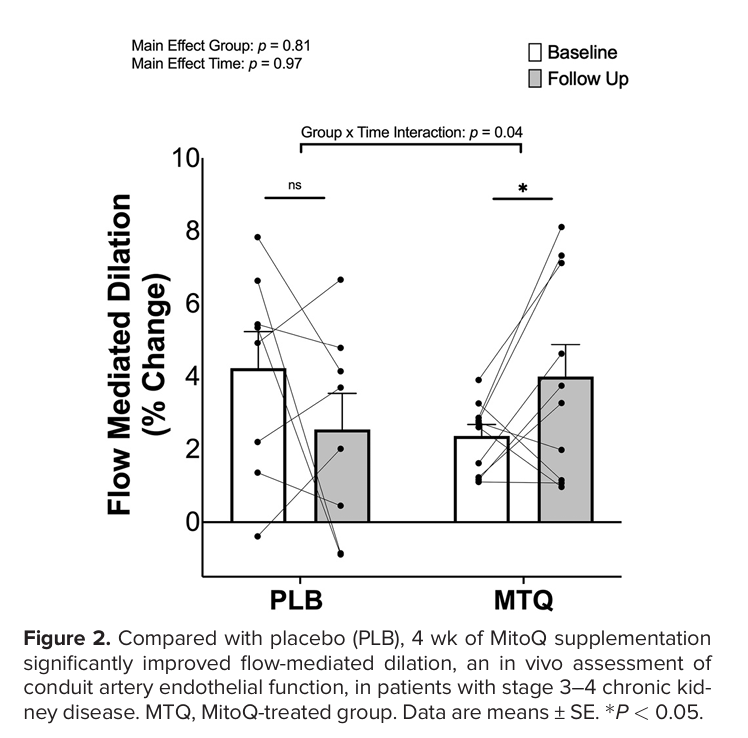
Image taken from Kirkman et al., 2023.
What Are the Implications for CKD Management?
These findings suggest that mitochondria-targeted approaches may meaningfully influence vascular health in CKD, particularly in the earlier disease stages before overt cardiovascular disease develops. As a pilot trial, the results primarily establish biological plausibility, demonstrate the feasibility of intervention in this population, and provide an early physiological signal to support the design of larger and longer trials capable of determining whether these changes translate into clinically meaningful outcomes.
What Should Practitioners Know About Dosing, Timing, and Safety?
Participants took 20 mg of MitoQ once daily for four weeks, typically before breakfast. The intervention was well tolerated, with high adherence and no serious adverse events reported. Kidney function remained stable across the study period, supporting the short-term safety of this approach in a population for whom drug tolerability is a frequent clinical concern.
Read the full paper: Effects of a mitochondrial-targeted ubiquinol on vascular function and exercise capacity in chronic kidney disease: a randomized controlled pilot study
DOI: 10.1152/ajprenal.00067.2023