Fatigue and cognition research: Mitoquinol (MitoQ) in fibromyalgia and chronic fatigue syndromes
Written by Georgia Truman (MSc), Molecular and Cellular Biology. Reviewed by Dr. Siobhan Mitchell (PhD), Neuroscience.
Fibromyalgia (FM), myalgic encephalomyelitis (ME), and chronic fatigue syndrome (CFS) are complex multi-system conditions characterised by fatigue, pain, cognitive dysfunction, and sleep disturbance. Mitochondrial dysfunction and oxidative stress have been implicated in their pathophysiology, making mitochondria-targeted interventions a potential therapeutic strategy. This study investigated whether a mitochondria-targeted antioxidant could improve symptoms and cognitive function in individuals with fibromyalgia and ME/CFS.
Research Summary
Evidence type: Mixed design (randomised crossover + open-label cohort)
Claim strength: Weak–moderate (subjective outcomes, non–peer-reviewed, mixed methodology)
Population: Fibromyalgia (n=47), ME/CFS (n=51), Additional open-label cohort (n=44)
Intervention: MitoQ 20 mg/day vs placebo (6 weeks)
Primary outcomes: Symptom ratings, pain, fatigue, cognition, wellbeing
Observed outcome: Fibromyalgia showed reduced pain and improved working memory; ME/CFS showed no benefit vs placebo; open-label cohort showed broad improvements without control
What you’ll learn
Whether mitochondrial-targeted antioxidants can improve symptoms in fibromyalgia and ME/CFS
How oxidative stress and mitochondrial dysfunction relate to fatigue and cognition
Why clinically similar conditions may respond differently to the same intervention
The role of study design and placebo effects in symptom-based research
Why mitochondrial function was targeted
Fibromyalgia and ME/CFS have both been associated with increased oxidative stress and impaired mitochondrial function, which may reduce cellular energy availability and contribute to fatigue, pain, and cognitive dysfunction. These links have led to interest in interventions that specifically target mitochondrial oxidative balance rather than relying on general antioxidant strategies.
What the study observed
Participants completed repeated symptom assessments and cognitive testing during periods of MItoquinol (also known as MitoQ) and placebo use within a crossover design.
In individuals with fibromyalgia, MItoquinol was associated with reductions in pain over time and improvements in working memory, measured by digit span performance. These effects were not observed during placebo periods, suggesting a condition-specific response.
In contrast, participants with ME/CFS showed no meaningful improvement compared with placebo across most outcomes, indicating that Mitoquinol did not influence symptoms under controlled conditions in this group.
An additional open-label cohort reported widespread improvements across multiple symptoms, though the absence of placebo control limits interpretation of these effects.
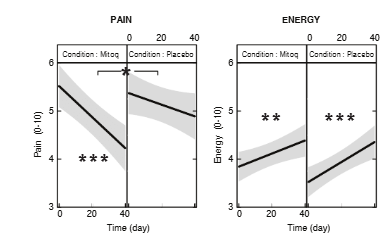
Image taken from Johnson et al., 2016
What are the implications for fatigue-related conditions?
This study highlights an important divergence between fibromyalgia and ME/CFS despite their overlapping symptom profiles. The observed benefit in fibromyalgia, but not in ME/CFS, suggests that mitochondrial dysfunction may play a more functionally limiting or therapeutically accessible role in fibromyalgia.
It also reinforces a broader pattern seen across the literature: interventions targeting mitochondrial oxidative stress appear to be most effective when mitochondrial dysfunction is a primary driver of disease, rather than a secondary or downstream feature.
Taken together, these findings suggest that mitochondrial-targeted supplementation may have condition-specific application, and that treating fatigue-related syndromes as biologically uniform may obscure meaningful differences in response. The strong effects observed in the open-label cohort further highlight the influence of expectation and placebo effects in symptom-driven conditions, underscoring the importance of controlled study design. In clinical practice, this supports a cautious, individualised approach — particularly positioning mitochondrial interventions as a potential adjunct in fibromyalgia, while indicating that ME/CFS may require broader, multi-targeted strategies to achieve meaningful symptom improvement.
What should practitioners know about dosing and use?
Participants took 20 mg daily for 6 weeks. The intervention demonstrated variable effects across populations, with benefits observed in fibromyalgia but not replicated in ME/CFS under placebo-controlled conditions. These findings emphasise the importance of population selection, study design, and expectation effects when interpreting outcomes for symptom-driven conditions.
Read the full paper: The influence of Mitoquinol on symptoms and cognition in fibromyalgia, myalgic encephalomyelitis and chronic fatigue
DOI: 10.13140/RG.2.1.2329.8805