Redox biology research: Mitoquinol (MitoQ) and mitochondrial ROS in middle-aged men
Written by Tyla Cornish (BNatMed), Naturopath. Reviewed by Dr. Siobhan Mitchell (PhD), Neuroscience.
Mitochondrial reactive oxygen species (ROS) are central to both cellular signalling and oxidative stress-related damage. While excessive ROS production has been linked to mitochondrial dysfunction and chronic disease, physiological ROS signalling plays an important role in maintaining normal cellular function.
This study investigated whether mitochondrial-targeted antioxidant supplementation could reduce mitochondrial ROS production and whether this translated into changes in mitochondrial function in healthy middle-aged men.
Research Summary
Evidence type: Randomised, double-blind, crossover clinical trial
Claim strength: Causal (mechanistic endpoints), neutral/mixed
Population: 20 healthy middle-aged men (~50 years)
Intervention: Mitoquinol (MitoQ) 20 mg/day, CoQ10 200 mg/day - 6 week period per condition (with washout)
Primary outcomes: Mitochondrial ROS (H₂O₂), mitochondrial respiration, oxidative stress biomarkers
Observed outcome: Reduced mitochondrial H₂O₂ production - Mitoquinol and CoQ10, Increased catalase expression with Mitoquinol, No change in mitochondrial respiration, density, or systemic oxidative stress.
Causality: Supported for mitochondrial ROS reduction
What you’ll learn
Whether mitochondrial-targeted antioxidants reduce ROS in human skeletal muscle
How changes in oxidative stress relate to mitochondrial function and energetics
Why lowering ROS does not necessarily translate into functional improvement
The difference between local mitochondrial effects and systemic oxidative stress outcomes
Why mitochondrial ROS was targeted
Mitochondria are a major source of reactive oxygen species, and excessive production has been linked to ageing and chronic disease. However, ROS also act as signalling molecules involved in mitochondrial adaptation and cellular homeostasis.
This creates a key therapeutic question: can selectively reducing mitochondrial ROS improve cellular health without disrupting normal signalling processes?
What the study observed
Participants completed two 6-week supplementation periods with MitoQ or CoQ10 in a crossover design, with detailed assessment of skeletal muscle mitochondrial function and oxidative stress. Mitoquinol supplementation reduced mitochondrial hydrogen peroxide (H₂O₂) production, particularly during leak respiration states where ROS generation is highest. Both Mitoquinol and CoQ10 improved markers of mitochondrial electron handling efficiency, indicating reduced electron leak during respiration.
Mitoquinol also increased expression of catalase, an antioxidant enzyme involved in detoxifying hydrogen peroxide, suggesting an adaptive upregulation of antioxidant defences.
However, despite these clear biochemical changes, there were no effects on mitochondrial respiration, mitochondrial density, gene expression related to biogenesis, or systemic oxidative stress markers.
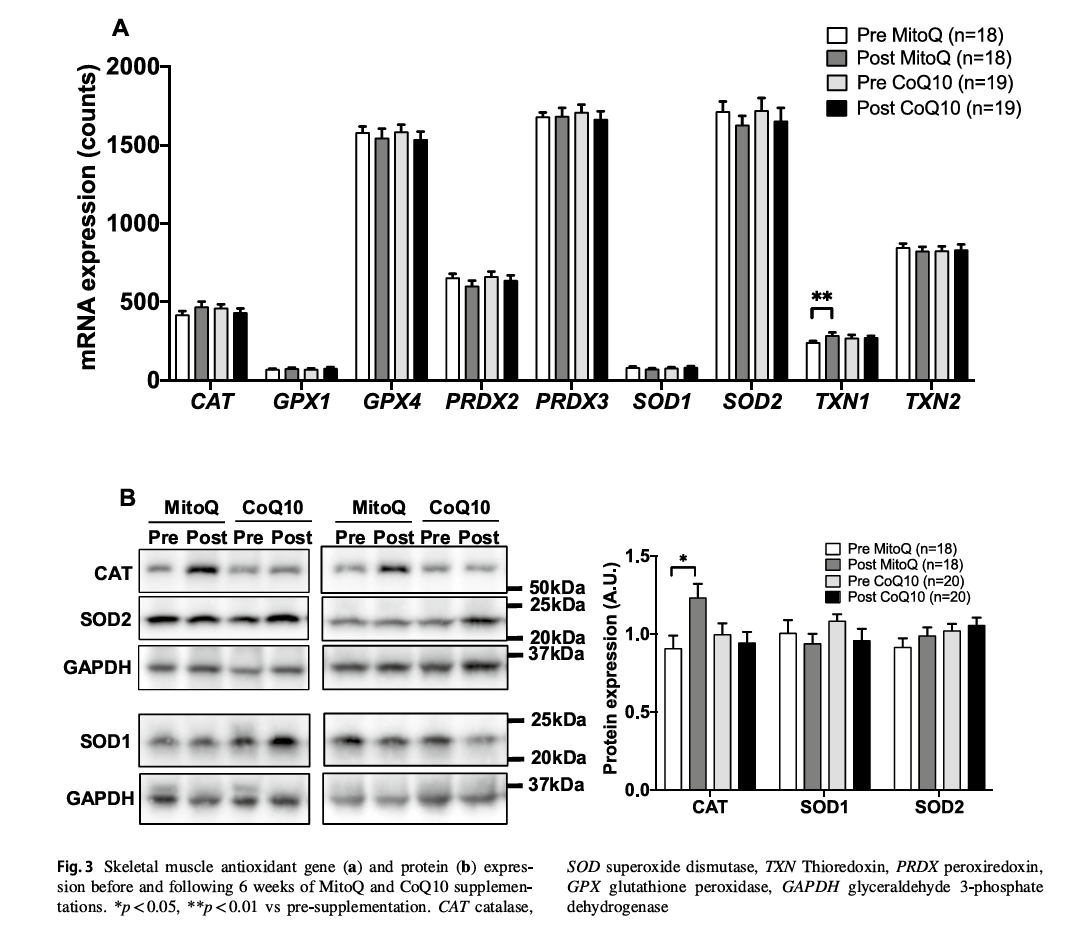
Image taken from Pharm et al., 2020.
What are the implications for mitochondrial function and health?
This study provides a clear example of a dissociation between biochemical modulation and functional outcome. While mitochondrial ROS levels were reduced, this did not translate into measurable improvements in mitochondrial function or systemic oxidative stress.
This finding is mechanistically important. It suggests that in healthy, middle-aged individuals, mitochondrial ROS levels may not be sufficiently elevated to impair function, and therefore lowering them does not produce a detectable physiological benefit.
It also reinforces the concept that ROS are not purely harmful. Reducing ROS without an underlying oxidative imbalance may have limited or neutral effects, as these molecules play essential roles in signalling pathways that regulate mitochondrial adaptation.
Taken together, these findings suggest that mitochondrial-targeted antioxidants may be most effective in contexts of elevated oxidative stress, such as ageing with comorbidities or disease states. In healthy populations, their role may be limited to modulating redox balance without altering functional outcomes. This positions MitoQ as a context-dependent intervention, with greater potential relevance where mitochondrial dysfunction or oxidative burden is already present.
What should practitioners know about dosing and use?
Participants took 20 mg daily for 6 weeks. The intervention reduced mitochondrial ROS without affecting mitochondrial function, was well tolerated with high adherence, and demonstrated that biochemical effects do not necessarily translate into functional outcomes.
Read the full paper: MitoQ and CoQ10 supplementation suppress skeletal muscle mitochondrial hydrogen peroxide levels without impacting mitochondrial function
DOI: 10.1007/s00421-020-04396-4