Cardiometabolic Research: Mitoquinol, Cardiac Energetics, and Diastolic Function in Type 2 Diabetes
Written by Tyla Cornish (BNatMed), Naturopath. Reviewed by Dr. Siobhan Mitchell (PhD), Neuroscience.
Type 2 diabetes is associated with impaired mitochondrial function and reduced cardiac energy production, which can contribute to early heart dysfunction even before clinical heart failure develops. This subclinical cardiomyopathy — characterised by energetic deficiency rather than structural failure — represents a compelling target for mitochondria-directed intervention. This study investigated whether mitochondrial antioxidant supplementation could improve cardiac energetics and function in individuals with type 2 diabetes without established cardiovascular disease.
Research Summary
Evidence type: Randomised, controlled clinical trial (open-label, blinded endpoint)
Claim strength: Causal (physiological endpoints), positive
Population: 70 adults with type 2 diabetes without established cardiovascular disease
Intervention: Mitoquinol 40 mg/day vs standard care (period of 16 weeks)
Primary outcomes: Cardiac energetics (PCr/ATP ratio), cardiac function (CMR), diastolic function
Observed outcome: Improved cardiac energetics at rest and under stress; improved diastolic function; no change in ejection fraction or perfusion
Causality: Supported for cardiac energetic improvements
Primary source: Heart (BCS Abstract, 2025)
What you’ll learn
Whether improving mitochondrial energy production can enhance cardiac function in type 2 diabetes
How cardiac energetics relate to early (subclinical) changes in diabetic cardiomyopathy
Why improvements in energetics and diastolic function may occur before structural cardiac changes
The role of mitochondrial dysfunction as an upstream driver of cardiometabolic disease progression
Why Mitochondrial Function Was Targeted in Diabetes
In type 2 diabetes, impaired mitochondrial energy production reduces ATP availability in cardiac tissue, contributing to early functional changes before structural remodelling becomes apparent. Increased oxidative stress further disrupts mitochondrial efficiency, creating an energy-deficient state in the myocardium that conventional pharmacological management may not adequately address.
What the Trial Observed
Participants received Mitoquinol or standard care over 16 weeks, with cardiac energetics assessed using advanced magnetic resonance spectroscopy imaging. The study found significant improvements in the myocardial phosphocreatine-to-ATP ratio (PCr/ATP) — a direct measure of cardiac energetic status — both at rest and under metabolic stress, alongside improvements in diastolic function. Overall cardiac output and perfusion were unchanged, indicating that effects at 16 weeks were concentrated at the energetic and early functional level rather than in gross structural parameters.
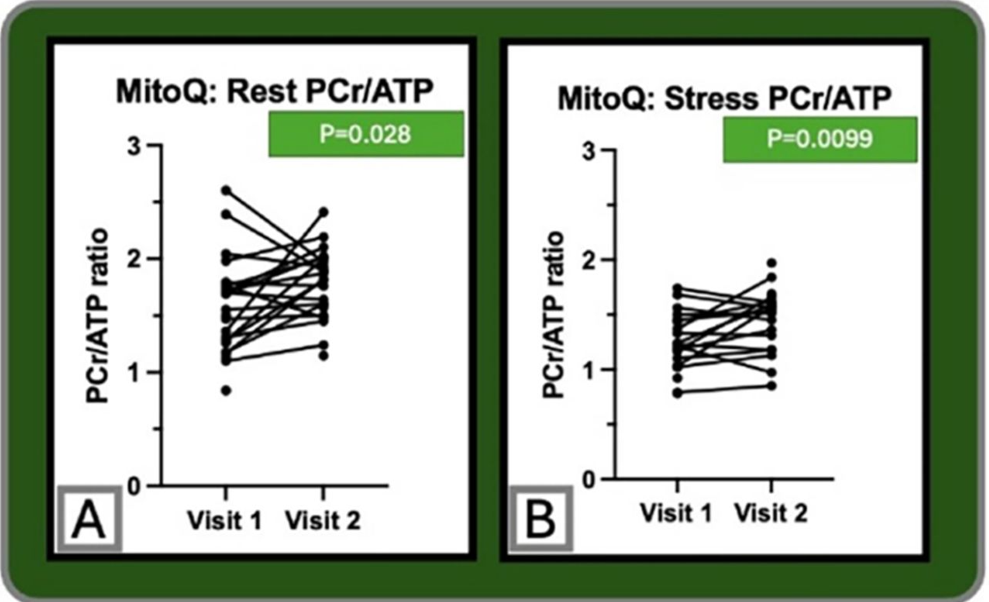
Charts demonstrating the interval change in MRS parameters before and after supplementation with MitoQ, showing significant improvements in rest PCr/ATP (A) (visit 1: 1.58 [1.41, 1.74] to visit 2: 1.78 [1.65, 1.91];P=0.028) and dobutamine-stress PCr/ATP (B) (visit 1: 1.25 [1.13, 1.36] to visit 2: 1.46 [1.34, 1.59];P=0.0099).
Image taken from Procter et al., 2025.
What Are the Implications for Cardiometabolic Health?
This study suggests that mitochondrial dysfunction is a modifiable contributor to diabetic heart disease and that improvements in cardiac energetics may precede structural changes, representing an earlier and potentially more reversible therapeutic window. For individuals with type 2 diabetes who are at risk of developing diabetic cardiomyopathy, early mitochondrial intervention may offer a strategy to slow or prevent progression to overt heart failure.
Taken together, these findings suggest that changes in myocardial energetics may serve as an early and sensitive indicator of therapeutic response, potentially preceding detectable changes in conventional cardiac imaging endpoints such as ejection fraction. The dissociation between improved energetics and unchanged structural parameters reinforces the concept that mitochondrial function sits upstream of functional decline, and that interventions targeting cellular energy metabolism may alter disease trajectory before irreversible remodelling occurs. This positions mitochondrial support as a strategy aligned with early intervention and prevention, particularly in patients with metabolic dysfunction but preserved cardiac output.
What Should Practitioners Know About Dosing and Use?
Participants took 40 mg daily for 16 weeks. The intervention was well tolerated, improved cardiac energetics and diastolic function, and did not alter structural cardiac parameters over this timeframe — a finding consistent with the hypothesis that energetic recovery precedes structural normalisation and that longer follow-up may be required to detect downstream structural benefit.
Read the full paper: The therapeutic potential of Mitoquinoluinone (Mitoquinol) in the treatment of diabetic cardiomyopathy
DOI: 10.1136/heartjnl-2025-BCS.283