Exercise Adaptation Research: Mitoquinol, PGC-1α Signalling, and Peak Power
Written by Tyla Cornish (BNatMed), Naturopath. Reviewed by Dr. Siobhan Mitchell (PhD), Neuroscience.
Reactive oxygen species (ROS) are not only markers of oxidative stress but also function as signalling molecules that drive exercise adaptation. Broad-spectrum antioxidant supplementation has been shown in some studies to interfere with these signalling processes, raising questions about whether more targeted approaches can preserve or enhance adaptive signalling without the blunting effects associated with general antioxidants. This study examined whether a mitochondria-targeted antioxidant could influence molecular signalling, mitochondrial adaptation, and performance outcomes during high-intensity interval training (HIIT).
Research Summary
Evidence type: Randomised, double-blind, placebo-controlled clinical trial
Claim strength: Causal, mixed-positive (signalling + specific performance metrics)
Population: 23 untrained middle-aged men
Intervention: Mitoquinol 20 mg/day vs placebo (10 days pre-exercise + 3 weeks HIIT)
Primary outcomes: Molecular signalling (PGC-1α expression); mitochondrial content and function; performance (VO₂peak, time trial, peak power)
Observed outcome: Increased exercise-induced PGC-1α expression; greater improvements in peak power; no change in VO₂peak or time trial performance; no effect on mitochondrial content or function
Causality: Supported for signalling and peak power outcomes
Primary source: Redox Biology
What you’ll learn
Whether mitochondria‑targeted antioxidants can influence exercise‑induced signalling pathways like PGC‑1α
How molecular signalling changes relate to downstream performance and mitochondrial adaptation
Why improvements in peak power may occur independently of aerobic capacity
The difference between early signalling responses and longer-term structural adaptations to training
Why Mitochondrial Signalling Was Targeted
Exercise adaptation relies on redox-sensitive signalling pathways, including PGC-1α, which regulates mitochondrial biogenesis and metabolic adaptation to training. Targeting mitochondrial ROS specifically may allow modulation of these pathways without interfering with the broader beneficial adaptations that depend on exercise-induced oxidative signalling — a more nuanced approach than general antioxidant supplementation.
What the Trial Observed
Participants completed high-intensity interval exercise and training following a period of supplementation. The study found greater increases in PGC-1α expression following acute exercise in the Mitoquinol group, as well as enhanced improvements in peak power output after training.However, there were no differences in VO₂peak or time trial performance, and no effect on mitochondrial content or respiratory function. These findings suggest that Mitoquinol influences redox-sensitive signalling pathways and specific performance outcomes without altering core mitochondrial adaptations to training.
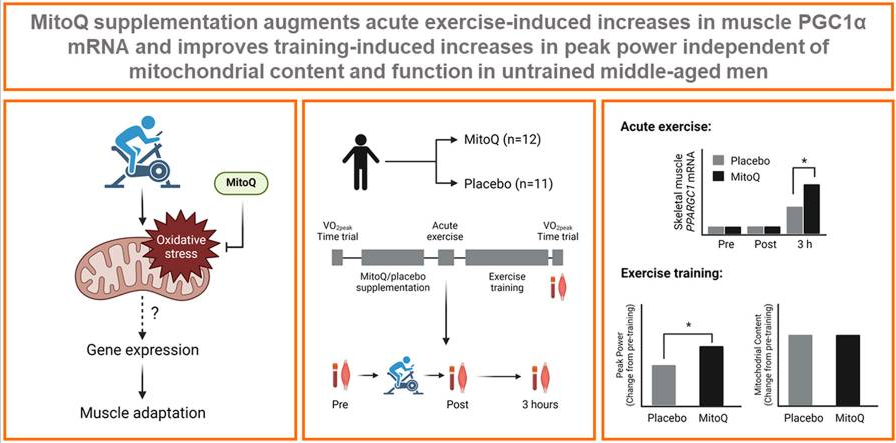
Image taken from Broome et al., 2022.
What Are the Implications for Performance and Adaptation?
This study reveals a nuanced effect of mitochondrial antioxidants: positive effects on signalling and high-intensity power outcomes, alongside neutral effects on aerobic capacity and mitochondrial adaptation. It suggests that Mitoquinol may preferentially enhance components of performance that are sensitive to acute redox signalling — such as peak power — while leaving aerobic indices unchanged. The selective modulation of adaptation pathways has implications for how mitochondria-targeted interventions might be positioned within training programmes.
These findings suggest that mitochondrial-targeted supplementation may act by amplifying early signalling responses to training rather than directly driving structural mitochondrial adaptation. The increase in exercise-induced PGC‑1α expression without corresponding changes in mitochondrial content highlights a potential temporal disconnect between signalling and downstream adaptation, indicating that longer intervention periods may be required for structural changes to emerge. This positions Mitoquinol as a potential adjunct for enhancing responsiveness to high-intensity training stimuli, particularly in populations initiating training or undergoing early-phase adaptation.
What Should Practitioners Know About Dosing and Use?
Participants took 20 mg daily before and during training. The intervention was well tolerated, enhanced molecular signalling responses to acute exercise, and improved peak power outcomes without altering aerobic capacity — a pattern that warrants further investigation in populations where high-intensity performance is a primary outcome.
Read the full paper: Mitoquinol supplementation augments acute exercise-induced increases in muscle PGC1α mRNA and improves training-induced increases in peak power
DOI: 10.1016/j.redox.2022.102341