Exercise Performance Research: Mitoquinoluinol (Mitoquinol), Oxidative Stress, and Vascular Signalling in Trained Cyclists
Written by Tyla Cornish (BNatMed), Naturopath. Reviewed by Dr. Siobhan Mitchell (PhD), Neuroscience.
Endurance training substantially increases reactive oxygen species (ROS) production, which can impair vascular function and limit oxygen delivery to working muscles. While some oxidative stress is required for training adaptations, excessive ROS may reduce performance by compromising endothelial signalling and nitric oxide availability. This study investigated whether mitochondrial antioxidant supplementation could reduce oxidative stress and improve molecular signalling pathways linked to vascular function and exercise performance in trained cyclists.
Research Summary
Evidence type: Randomised, double-blind, placebo-controlled clinical trial
Claim strength: Causal (within trial), mixed-positive (mechanistic > performance)
Population: 32 professional cyclists
Intervention: Mitoquinol 20 mg/day; exercise training (EX); combined Mitoquinol + EX (4 weeks)
Primary outcomes: Oxidative stress, antioxidant enzymes, miRNA expression, VO₂max
Observed outcome: Reduced reactive oxygen species with Mitoquinol (alone and with training); increased antioxidant enzyme activity; modulation of miRNAs linked to vascular inflammation; no change in VO₂max
Causality: Supported for molecular and biochemical endpoints
Primary source: Brazilian Archives of Biology and Technology
What you’ll learn
Whether reducing mitochondrial oxidative stress improves performance outcomes in trained athletes
How molecular and biochemical adaptations differ from measurable performance metrics like VO₂max
The role of reactive oxygen species in both limiting and supporting endurance performance
Why outcome selection and study duration influence detection of performance benefits
Why Oxidative Stress Was Targeted in Endurance Training
During prolonged or high-intensity exercise, mitochondrial activity increases substantially, leading to elevated ROS production. While ROS play a role in signalling adaptations, excessive levels can impair endothelial function, reduce nitric oxide availability, and limit oxygen delivery to working muscles — creating a potential target for mitochondria-directed interventions in athletes performing at high training loads.
What the Trial Observed
Participants were assigned to placebo, Mitoquinol alone, exercise training, or combined Mitoquinol and training for four weeks. The study found significant reductions in ROS levels with Mitoquinol supplementation, increases in antioxidant enzyme activity across intervention groups, and changes in circulating microRNAs associated with vascular inflammation and oxidative signalling. However, no improvement in VO₂max was observed across groups, indicating that while Mitoquinol influenced biochemical and molecular markers, these changes did not translate into measurable improvements in aerobic capacity over the study period.
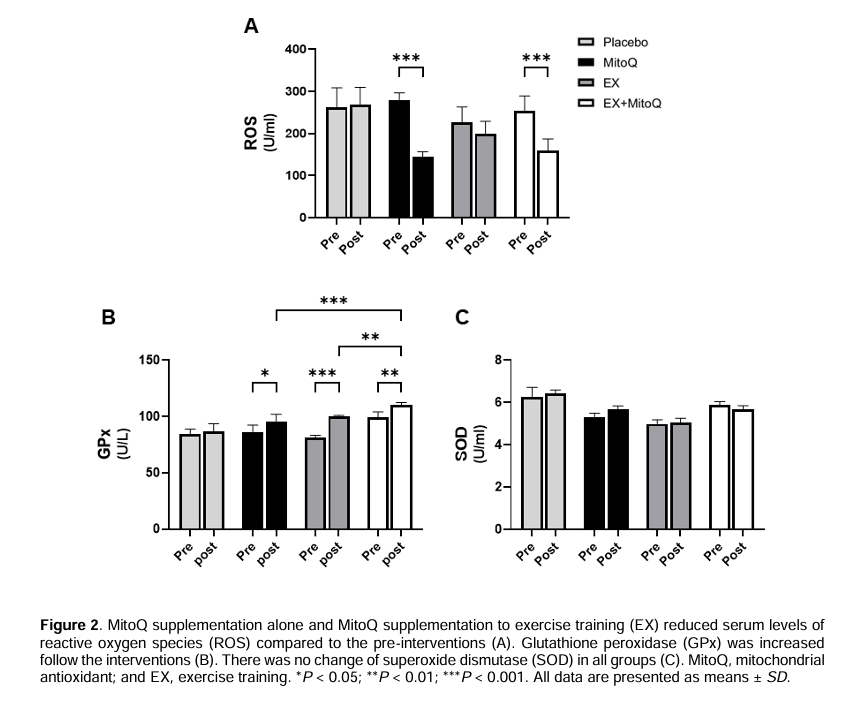
Image taken from Aminizadeh et al., 2023.
What Are the Implications for Performance and Training?
This study highlights an important and recurring distinction in the Mitoquinol literature: improvements in physiological and molecular markers do not automatically translate into measurable performance gains, at least not within the timeframe studied. The biochemical improvements observed — reduced ROS, increased antioxidant enzyme activity, and modulation of vascular inflammatory miRNAs — are biologically meaningful and suggest that Mitoquinol was engaging its intended targets. The absence of VO₂max improvement is therefore most plausibly a question of time and outcome selection rather than a failure of biological activity.
VO₂max is a highly integrated endpoint determined by cardiac output, haematological oxygen-carrying capacity, and peripheral muscle extraction — all systems that adapt slowly and require sustained training stimulus over months rather than weeks to shift meaningfully in already-trained athletes. In professional cyclists, VO₂max may also be approaching its genetically determined ceiling, making incremental improvements inherently difficult to detect regardless of the intervention. A four-week study in this population is arguably too short and the outcome measure too distal from the molecular changes observed to constitute a fair test of performance potential.
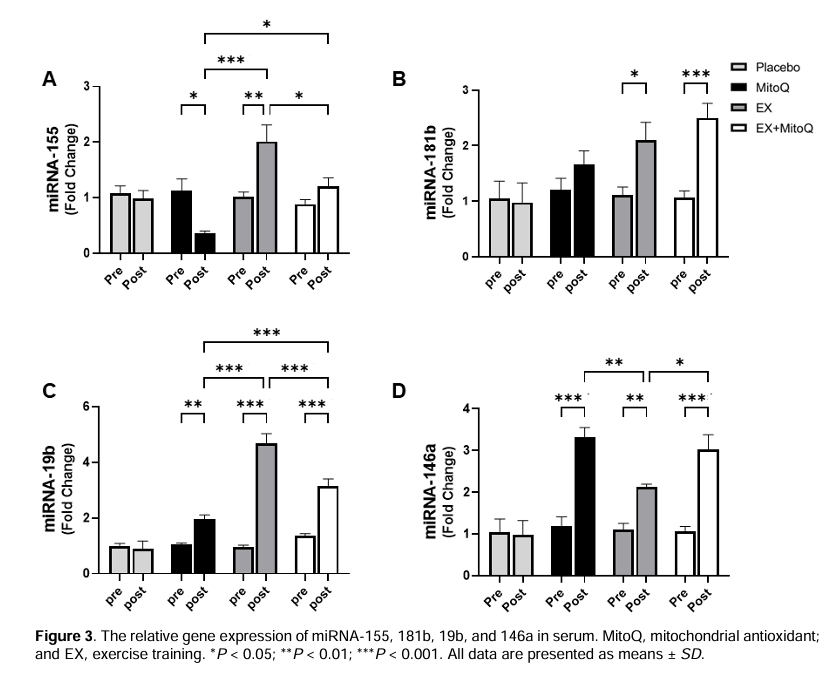
Image taken from Aminizadeh et al., 2023.
Critical Considerations for Future Research
Future trials should prioritise outcome measures that sit closer to the biological changes Mitoquinol produces. Submaximal efficiency metrics — such as the power output at lactate threshold, oxygen cost at a fixed work rate, or cycling economy — are more sensitive to vascular and mitochondrial changes than VO₂max and could detect meaningful differences over shorter intervention periods. Given the miRNA findings, incorporating assessments of endothelial function alongside performance measures would help establish whether the molecular changes observed translate into vascular adaptations relevant to oxygen delivery during exercise. Extending the intervention to eight to twelve weeks would also allow sufficient time for any vascular and cellular improvements to propagate into performance-level adaptations.
What Should Practitioners Know About Dosing and Use?
Participants took 20 mg of Mitoquinol daily for four weeks. The intervention was well tolerated, produced measurable reductions in oxidative stress, and influenced molecular regulators of vascular function. The absence of VO₂max improvement should be interpreted in the context of both study duration and the biological gap between biochemical change and performance adaptation — not as evidence that the molecular changes are without functional relevance.
Read the full paper: Mitoquinol Supplementation During Vigorous Training Improves Reactive Oxygen Species, Glutathione Peroxidase, and miRNAs Regulating Vascular Inflammation in Cyclists
DOI: 10.1590/1678-4324-2023220914