Hypertension Research: Mitoquinol and Cardiovascular Function in Hypertensive Adults
Written by Tyla Cornish (BNatMed), Naturopath. Reviewed by Dr. Siobhan Mitchell (PhD), Neuroscience.
Hypertension is strongly associated with oxidative stress, inflammation, and vascular dysfunction, all of which contribute to elevated cardiovascular risk. While exercise is a well-established intervention for managing these pathways, mitochondrial dysfunction has emerged as an additional therapeutic target that exercise alone may not fully address. This study examined whether mitochondrial antioxidant supplementation, alone or combined with endurance training, could improve cardiovascular and inflammatory markers in individuals with hypertension.
Research Summary
Evidence type: Randomised, double-blind, placebo-controlled clinical trial
Claim strength: Causal (within trial), positive physiological outcomes
Population: 52 middle-aged adults with hypertension
Intervention: Mitoquinol 20 mg/day; endurance training (ET); combined Mitoquinol + ET (6 weeks)
Primary outcomes: Blood pressure, cardiac structure/function, oxidative stress, inflammation, miRNA expression
Observed outcome: Reduced systolic blood pressure; improved cardiac structure (reduced left ventricular mass); reduced oxidative stress and inflammation markers; increased antioxidant capacity; greater effects when combined with exercise
Causality: Supported for cardiovascular and biochemical endpoints
Primary source: Cell Journal
What you’ll learn
Whether targeting mitochondrial oxidative stress can improve cardiovascular function in hypertension
How mitochondrial dysfunction contributes to vascular remodelling and elevated blood pressure
Why combining supplementation with exercise may produce additive physiological benefits
The difference between short-term physiological improvements and long-term clinical outcomes
Why Mitochondrial Function Was Targeted in Hypertension
Hypertension is associated with increased reactive oxygen species, inflammation, and endothelial dysfunction, with mitochondria acting as a major source of oxidative stress in vascular tissues. Exercise improves many of these pathways but may not fully address mitochondrial dysfunction in all individuals, suggesting that combined strategies could offer additive benefit where standalone exercise is insufficient.
What the Trial Observed
Participants were randomised into four groups — placebo, Mitoquinol alone, exercise alone, or combined Mitoquinol and exercise — and followed for six weeks. Systolic blood pressure decreased across all active intervention groups, with the greatest reduction observed in those receiving both Mitoquinol and exercise.Cardiac structure improved, including reductions in left ventricular mass and chamber dimensions, alongside decreases in oxidative stress markers, reductions in the pro-inflammatory cytokine IL-6, and increases in antioxidant capacity. Changes in circulating microRNAs associated with cardiovascular function were also observed, providing a molecular dimension to the physiological findings.
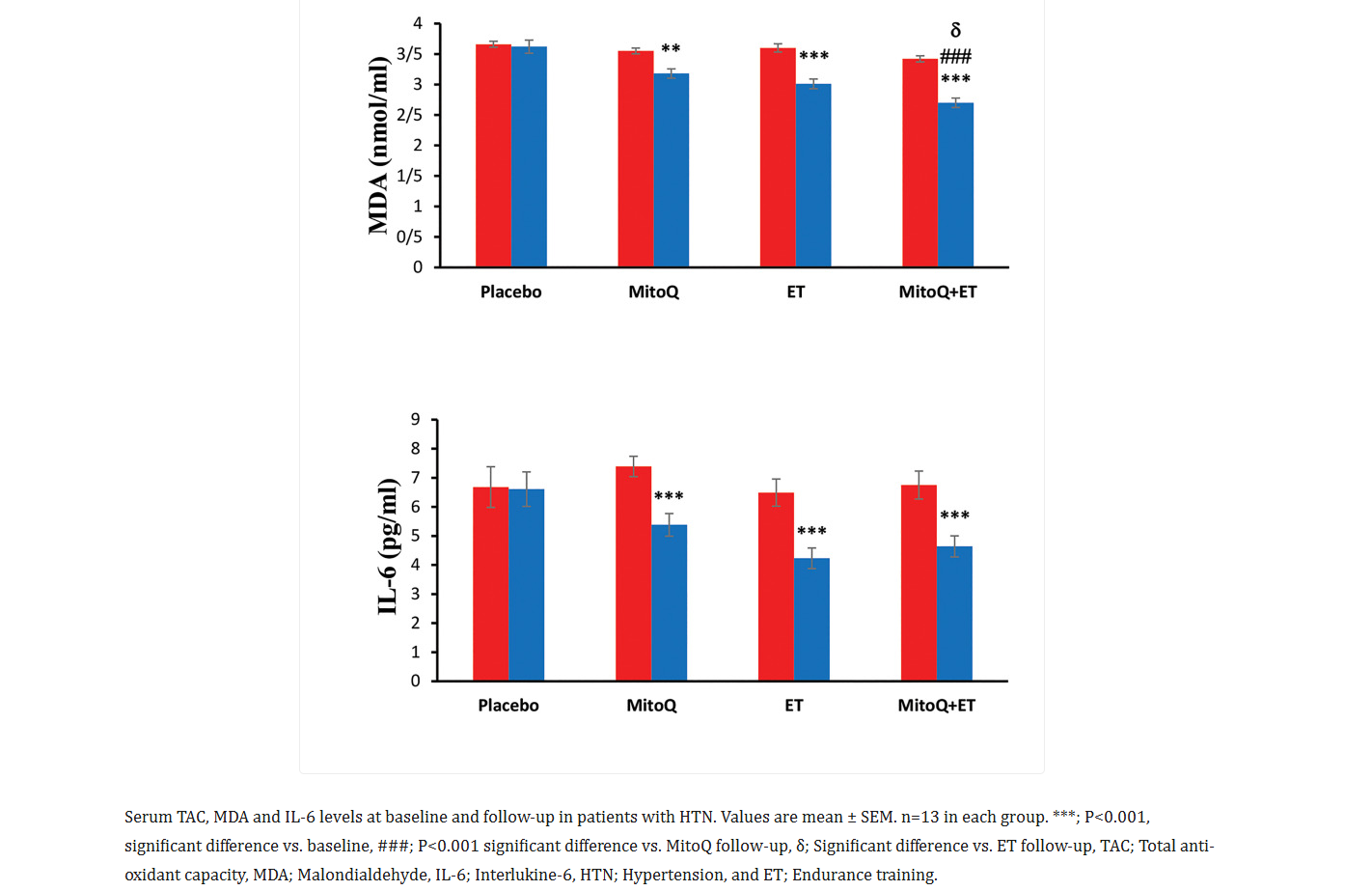
Image taken from Masoumi-Ardakani et al., 2022.
What are the Implications for Practice and Research?
This study supports mitochondrial oxidative stress as a modifiable contributor to hypertension and cardiovascular dysfunction, and highlights the potential for mitochondria-targeted interventions to complement established lifestyle-based approaches. The additive benefit observed with combined Mitoquinol and exercise is clinically relevant, suggesting that supplementation may amplify the cardiovascular effects of exercise in individuals where oxidative burden is a limiting factor. The modulation of circulating miRNAs also points to mechanisms of therapeutic interest for future investigation.
Taken together, these findings suggest that mitochondrial-targeted interventions may be particularly relevant in individuals who demonstrate suboptimal response to exercise alone, or where vascular remodelling and oxidative stress remain elevated despite standard care. The observed structural cardiac changes over a relatively short duration reinforce the concept that mitochondrial dysfunction is not only functionally relevant but may also contribute to early anatomical adaptations in hypertension, positioning mitochondrial support as a potential upstream strategy rather than solely a symptom-targeted approach.
What Should Practitioners Know About Dosing and Use?
Participants took 20 mg of Mitoquinol daily for six weeks alongside structured moderate-intensity exercise where applicable. The intervention was well tolerated, and improvements were observed across multiple cardiovascular and biochemical markers, supporting both its safety and biological relevance in this population.
Read the full paper:Moderate Endurance Training and Mitoquinol Improve Cardiovascular Function, Oxidative Stress, and Inflammation in Hypertensive Individuals
DOI: 10.22074/cellj.2022.8089